CCNA vs CCNA Automation: Which to Take First
Compare the two Cisco associate exams, check the skills each assumes, and choose a starting point that fits your networking and programming experience.
Two credentials, and neither requires the other
CCNA and CCNA Automation are separate Cisco certifications. Neither is a prerequisite for the other, so you can take them in either order. If networking is new to you, begin with networking fundamentals before deciding which exam to take.
CCNA uses exam 200-301 and tests addressing, switching, routing, services, security, and related topics. CCNA Automation uses exam 200-901 and tests software and APIs applied to networks, including programming, Cisco platforms, and infrastructure automation.
CCNA Automation was previously called DevNet Associate. The name changed on February 3, 2026; the associate exam number and content stayed the same. Older resources may still use DevNet Associate or DEVASC. Check their exam number and topic version before adding them to your study plan. Cisco’s announcement; Cisco’s explanation of the associate exam transition.
Cisco lists no formal prerequisites for either certification. That makes the order a decision about your existing skills and intended work. CCNA certification; CCNA Automation certification.
Subject matter side by side
This comparison uses 200-301 CCNA v1.1 and 200-901 CCNAAUTO v1.1, checked October 2, 2026. Cisco calls its published list of exam topics a blueprint. Each of these blueprints has six weighted domains.
| CCNA v1.1 | CCNA Automation v1.1 | |
|---|---|---|
| Exam | 200-301 | 200-901 |
| Main focus | Operating and troubleshooting networks | Developing and using software to work with networks |
| Domains and weights | Network Fundamentals 20%; Network Access 20%; IP Connectivity 25%; IP Services 10%; Security Fundamentals 15%; Automation and Programmability 10% | Software Development and Design 15%; Understanding and Using APIs 20%; Cisco Platforms and Development 15%; Application Deployment and Security 15%; Infrastructure and Automation 20%; Network Fundamentals 15% |
| Duration | 120 minutes | 120 minutes |
| Listed exam fee | US$300 | US$300 |
Sources: CCNA v1.1 exam topics, CCNAAUTO v1.1 exam topics, 200-301 exam details, and 200-901 exam details. Confirm the fee and any applicable taxes when booking; exam fees are separate from preparation-course costs.
CCNA gives its largest share, 25 percent, to IP Connectivity. That includes interpreting routing tables, configuring static routes, and working with single-area OSPFv2. CCNA Automation gives 20 percent each to API use and infrastructure automation. Its tasks include constructing REST requests, interpreting responses, and understanding automated workflows.
Picking your starting point
Check what you can do before choosing a certification sequence. The illustration suggests a diagnostic task for three starting backgrounds. Each task identifies something to study; it is not an exam-readiness test.
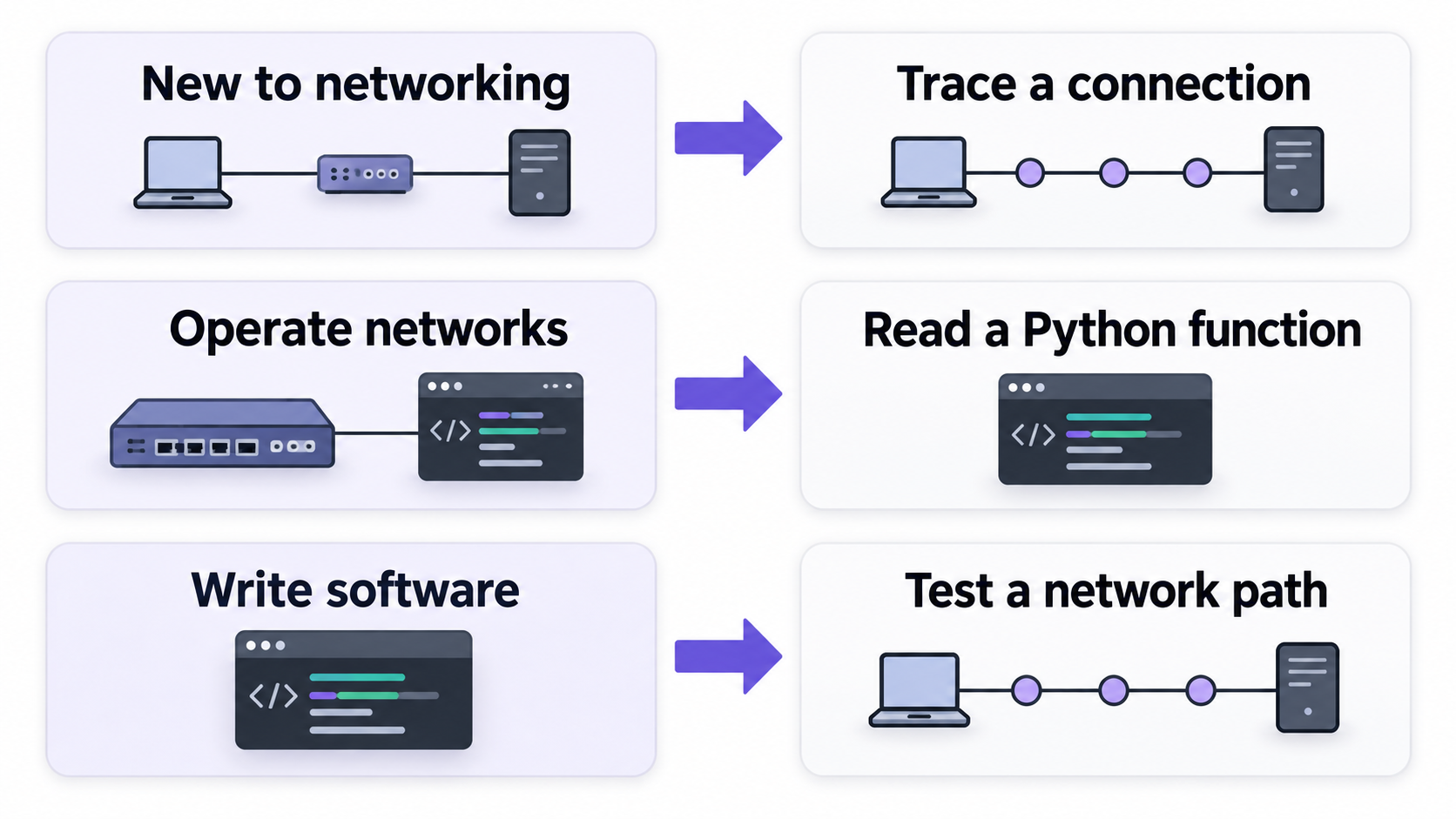
If you are new to networking, trace a connection from a laptop to a service on another subnet. Explain the roles of the IP address, subnet mask, default gateway, and DNS. If those terms are unfamiliar, study networking fundamentals first. CCNA topics provide a useful structure, whether or not you take the 200-301 exam before 200-901. A required certification deadline may determine your exam order, but you will still need those foundations.
If you already operate networks, read a short Python function that processes device records. Predict its output, change one condition, and explain the result. If you can troubleshoot network connectivity but cannot yet follow the code, programming is the more useful starting point for automation study. For a CCNP or ENCOR-level engineer, 200-901 may fit the goal of adding automation. Check your recall against its Network Fundamentals objectives before assuming that domain needs no review.
If you already write software, test a network path and explain where a failed connection stops. Distinguish a name-resolution failure from a routing problem and from an application rejecting a request. Programming experience helps with 200-901, but it does not replace the networking knowledge needed to diagnose those failures.
If you recently passed CCNA, 200-901 is one possible next step. Choose it when APIs, programming, and automation match the work you want to do. If your priority is deeper routing, switching, or security, compare the relevant professional-level paths as well.
Where the exams overlap
CCNA Automation assigns 15 percent to Network Fundamentals. Its objectives include addressing, gateways, DHCP, DNS, NAT, common protocol ports, MAC addresses, VLANs, and the effect of network constraints on applications. A CCNA holder will recognize much of this material, although 200-901 approaches it through application connectivity.
In the other direction, CCNA v1.1 assigns 10 percent to Automation and Programmability. It introduces controller-based networking, software-defined architectures, AI and machine learning in network operations, REST APIs, Ansible, Terraform, and JSON data.
The overlap is partial. Recognizing how an API works is different from constructing a request and handling its response. Passing one exam can help you prepare for the other, but you must pass each exam separately to earn both certifications. Use the two topic lists to identify shared material and the skills you still need to practice.
Account for the CCNA change in 2027
Cisco has announced that CCNA v2.0 begins on February 3, 2027. The last day to take v1.1 is February 2, 2027. The exam code remains 200-301. If your study plan crosses that date, use the topic list for the version you intend to take. Cisco’s transition FAQ.
The revised blueprint has five domains and places more emphasis on practical skills and troubleshooting. Its AI, Network Operations and Management domain accounts for 10 percent. REST APIs and JSON are not named as standalone objectives in the v2.0 list; that wording does not guarantee that related concepts cannot appear in an exam scenario. The six-domain CCNA comparison above applies to v1.1. Cisco’s refresh announcement; CCNA v2.0 exam topics.
Where the RouteSwitchU course fits
CCNA Automation Exam Prep is designed for the 200-901 candidate. It combines lessons with graded browser exercises, three capstones, and five drill decks. Basic Python is a prerequisite. If functions, lists, dictionaries, and exceptions are unfamiliar, begin with Python Foundations.
The required course exercises use fixed example data and run in your browser. You do not need to install Python or reserve a Cisco sandbox to complete them. Live platform work provides different practice, including connection setup, permissions, and changing device state. Our practice-options Field Note explains those differences.
Before choosing the course, review the CCNA Automation Knowledge Matrix. It maps the published objectives to lessons and records known gaps and practice limits. A lesson reference does not mean an entire objective has been taught and assessed. The 200-901 exam guide provides more detail on planning your preparation.
RouteSwitchU is an independent training publisher and is not affiliated with, endorsed by, or sponsored by Cisco Systems, Inc. Cisco and CCNA are trademarks of Cisco Systems, Inc.
Comments: comments@routeswitchu.com. Corrections: corrections@routeswitchu.com.