Field Notes
Technical notes, career advice, and study guidance for network engineers. Explore networking, automation, and AI through practical examples, lab results, and sources you can check.
Cisco quantum readiness: what your router actually supports
A working tunnel does not prove quantum protection. Check the exact Cisco platform, negotiated session, management service, and hardware trust requirements.
Read note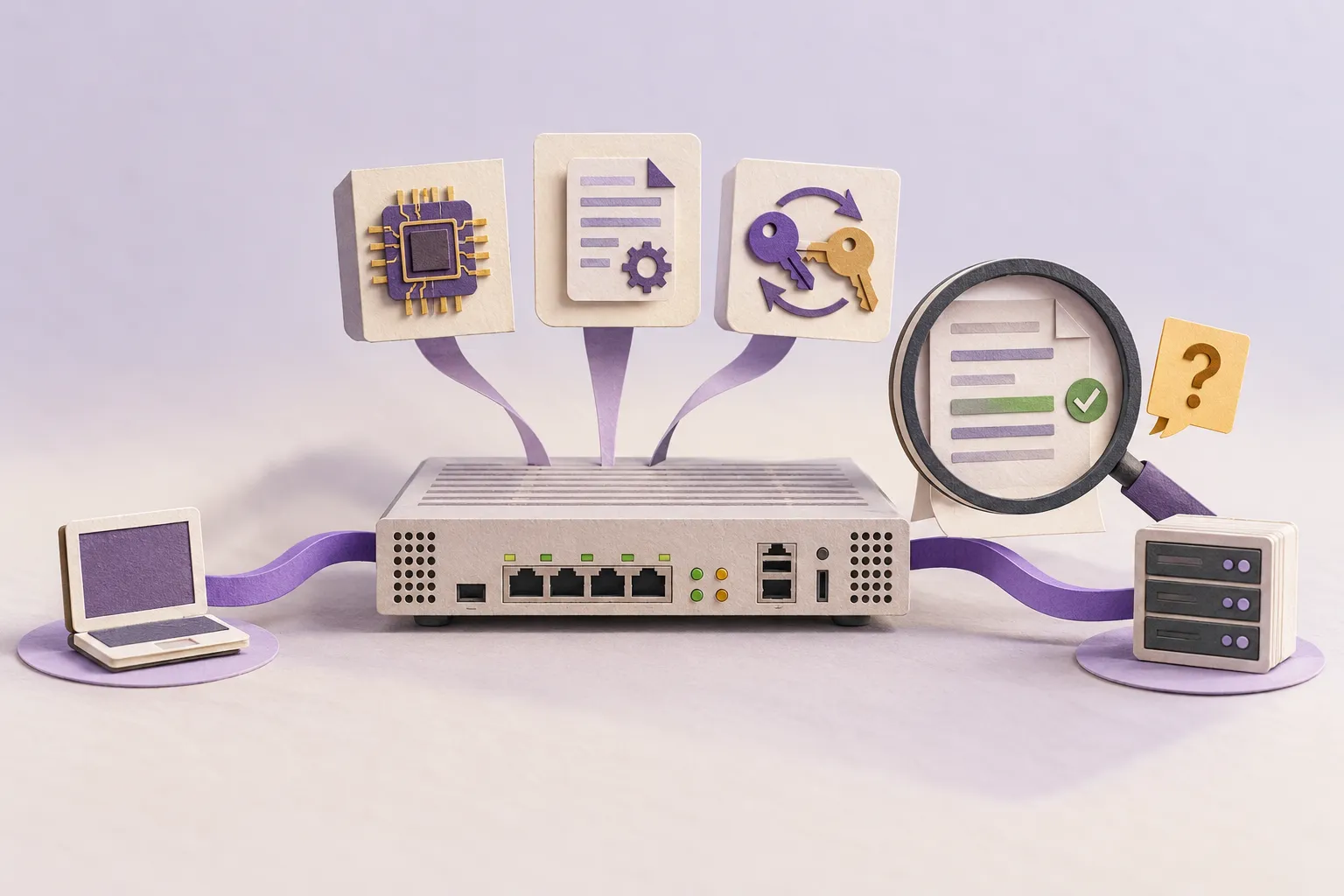
The quantum threat: why encrypted traffic needs a migration plan
Understand harvest now, decrypt later, the limits of forward secrecy, and how data lifetime changes enterprise post-quantum migration priorities.
Read noteQuantum readiness standards: from ML-KEM to deployment evidence
Understand what NIST's post-quantum standards cover, how protocols use them, and what evidence an enterprise network needs before claiming quantum readiness.
Read noteCCNA vs CCNA Automation: Which to Take First
Compare the two Cisco associate exams, check the skills each assumes, and choose a starting point that fits your networking and programming experience.
Read note200-901 labs without a sandbox reservation
Compare browser exercises, local Python, and Cisco sandbox practice, and try a graded example using fixed data.
Read noteCCNA Automation exam guide: 200-901 topics and preparation
Understand the 200-901 exam, the DevNet Associate rename, practice options, and the coverage limits of RouteSwitchU exam prep.
Read noteInside the 6 GHz power mode toolkit: decide, configure, verify, monitor
A public repo that walks the whole 6 GHz Low Power Indoor versus Standard Power decision on a Cisco Catalyst 9800: a questionnaire that refuses to recommend Standard Power over a missing prerequisite, NETCONF scripts for the one configuration bit, and a pyATS precheck that reports controller-side readiness as pass or fail. Lab-verified on a live controller, then audited three times before publishing.
Read noteMeraki is deprecating SNMPv1: what to do before your next firmware upgrade
Cisco Meraki is dropping SNMPv1 from upcoming MR, MX, and MS firmware, and the two copies of the announcement we received disagree about which MR release does it. Here is what breaks if you ignore the email, why SNMPv2c only postpones the work, and the order to do the migration in.
Read noteShort or long spanning tree path costs: which one to run and what mixing them does
Short path costs come from a 1998 table that runs out of room at 10 Gbps and gives every faster link the same cost of 1, so a single gigabit link can beat three 10 Gbps hops. Long costs fix the arithmetic. Nothing in the protocol notices a network running both methods, because the number on the wire is only a number.
Read noteA transcript of AI writing broken network automation, and the check that caught it
We asked a coding assistant to turn LLDP neighbor output into a topology diagram. The script exited 0 and produced valid Mermaid, but it drew every cable twice. This transcript includes the returned code, its output, the twelve-line check that reported the duplicate links, and the one-line fix.
Read noteWhat eight forward deployed engineer postings require from network engineers
We compared eight live forward deployed engineer postings with a senior network engineering resume. Network engineers can usually show the customer delivery, travel, troubleshooting, and operational experience these roles require. The missing proof is production software and, for AI roles, LLM systems that were built and evaluated.
Read noteTurn LLDP or CDP output into a network diagram, in the browser, free
We built a free browser tool that turns show lldp neighbors or show cdp neighbors output into a rendered Mermaid topology diagram. It handles the brief tables and the detail forms, merges duplicate links, and nothing you paste leaves the page. Here is how it handles inconsistent neighbor output, what the diagram cannot show, and what to keep after the first run.
Read noteForward deployed engineering for network engineers: role, requirements, and a practical path
Forward deployed engineers build inside customer environments and stay responsible through production. Network engineers already bring useful production experience, but they still need to prove they can write, test, and operate software. Here is what current postings ask for and how to build the missing evidence.
Read noteCan AI draw my network diagram?
It drafts well and it invents links. The fix is structural. Never ask a model for the picture; ask it for the code that builds the picture from your data, then check the rendered result against the data with a script rather than with your eyes.
Read noteDiagrams as code or a drawing tool: when each one wins
Generated text diagrams stay accurate when the network underneath keeps changing. Drawing tools matter when position on the page carries meaning, or when the diagram only needs to be drawn once for an audience. Most teams need both, and the split is predictable.
Read noteHow do I generate a network diagram from LLDP output?
Collect neighbors with the detail command, normalize each link into a four-field record, deduplicate the two reports of every cable, then print Mermaid. Parsing is where this goes wrong, and it gets most of the space below.
Read noteHow do I keep network diagrams from going stale?
Diagrams go stale because updating them is a separate task from making the change. Generate the diagram from collected state, commit it, and have CI regenerate and compare it, so a drifted diagram fails a check instead of waiting for someone to notice.
Read noteMermaid syntax for network topology: the full reference
Every piece of Mermaid flowchart syntax a network engineer needs, with the escaping rules, the styling that separates tiers, the renderer differences between GitHub and Obsidian, and the version bug that draws an arrowhead on a link you wrote as undirected.
Read noteNetwork diagrams as code: Mermaid for network engineers
A working reference for documenting a network in text instead of a drawing tool. The flowchart grammar, the patterns for campus topology, the sequence and state diagrams worth knowing, and the Python that generates the whole thing from LLDP neighbor data.
Read noteFrom CLI to NetDevOps: a 90-day plan for a CCNP-level engineer
For a CCNP-level engineer, this is the bridge from CLI fluency to code: Python through network data, Netmiko, device APIs, Git and CI, and AI you verify. Here is the plan, with a checkpoint you can grade at day 30, 60, and 90.
Read noteGraded labs vs. video courses: how network engineers actually learn automation
A video shows someone else configure a device. A graded lab checks your own work and tells you when it fails. Here is a real grading run from one of our labs, the failure included, plus an honest look at where video courses still fit.
Read noteYou don't need a home lab to learn network automation
We priced five ways to practice network automation, timed our own browser labs with a stopwatch, and wrote down where a home lab still wins. The setup-tax table and the grading transcript are in this note.
Read noteWhat $250 buys in network automation training (subscription math included)
Every price in this note was checked against the vendor's public pricing page on 2026-08-13. The table includes what each option costs at a realistic six-month pace, not the pace the marketing assumes.
Read noteAn AI agent fixed a broken OSPF adjacency in a four-router lab
Three classic OSPF breaks in a four-router lab. An AI agent with CLI access had to find and fix each one. Here is the transcript and the score.
Read noteHello, world!
This first note explains what Field Notes is, how every note gets tested before it publishes, and includes one small program that holds us to that standard.
Read note